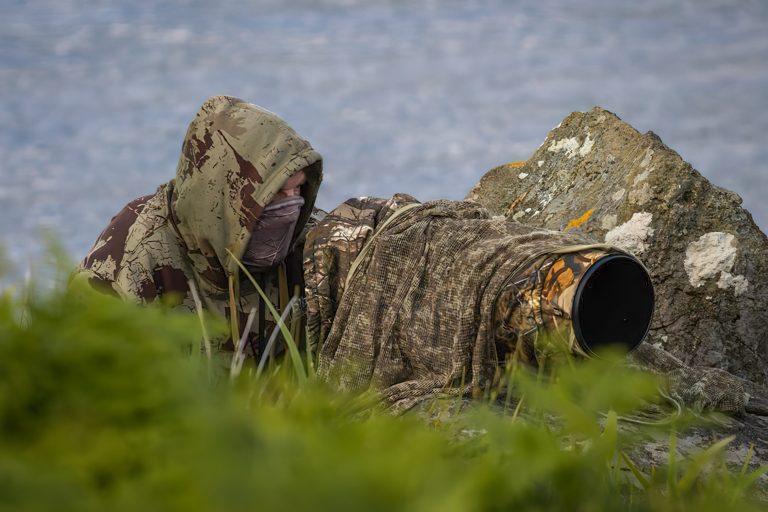
It always amuses me when I see a good photograph posted on social media and someone says “What settings did you use?” As wildlife photographers (I am not referring to paid hides with artificial lighting or flash) we must rely on one light source, the sun. The strength of the light depends on how high the sun is in the sky and different densities of cloud cover. The point I am making is the light changes at the blink of an eye so asking about camera settings on a posted photograph is irrelevant.
I do have go to settings when I go out looking for otters. I usually set my camera (Canon r5 mkii, or r3 + 800mm f5.6) at 1/800th– 1000th @ f8 (lens sweet spot) with 800 ISO.
You might be asking yourself why 1/800 or 1/1000 sec? The reason for that is there is a golden rule within photography circles which states: “When hand held, the shutter speed should be equal too or greater than the focal length of the lens that you are using”. This is basically to reduce camera shake. If you are using some kind of rest i.e. bean bag, monopod, tripod etc then the shutter can be reduced to suit the conditions and circumstance of the shoot.
Once I am in a suitable position in the rocks waiting for the otter to come towards me, I always, and I cannot stress this enough, take test shots. I never use “auto” I will use full manual or shutter priority. Find some dark coloured rock or seaweed that matches the colour of an otter’s fur and take test shots to ensure that you have the correct exposure and if necessary, check your histogram to ensure that the highlights are not blown out and your shadows are not too dark. This simple tip is so important.